Saturday, November 10, 2012

Sharpen your veterinary skills

Mini Veterinary School


Teaching case for wanna be veterinarians. 

If you enjoy figuring out  veterinary medical puzzles, we have a treat for you. 
We will give you a chance to test your medical skills. 
Answer the questions honestly, and don't peek at the answers. 
There is 15 available points if you answer all the questions correctly. 


Vinnie Bag of Donuts

We met Vinnie  on September 26th.  He is a 9yr old  neutered male indoor-only Maine Coone who had been overweight all his life. 

Presenting  complaints: 

Weight loss of  3-4 weeks duration.
Complete loss of appetite for three days, vomiting for a day.

Vinnie's  Diet : Dry. (Ingredients: http://www.hillspet.com/products/sd-feline-adult-indoor-dry.html)


Symptoms and Examination findings: 

Marked depression / loss of energy
Loss of appetite
Weight loss
Nausea and vomiting
Drooling / hyper salivation
Moderate Dehydration
Yellowing of the whites of the eyes and skin
Enlargement on  cranial abdominal palpation
----------------------------------------------------------------------------------------------------------------------------------
What tests  would you order? 

a) EKG
b) urinalysis
c) blood test + urinalysis
d) X-ray
e)blood test


Give yourself 2 points if you answered c) blood test + urinalysis and scroll down to read the results.

------------------------------------------------------------------------------------------------------------

12.2
4.2 - 15.6 K/uL
6.05
6.0 - 10.0 M/uL
8.1
9.5 - 15 g/dL
LOW
25.1
29 - 45 %
LOW
42
41 - 58 fL
13.4
11.0 - 17.5 pg
32.3
29 - 36 g/dL
% RETICULOCYTE
0.3
%
RETICULOCYTE
18
3 - 50 K/uL
RETICULOCYTE COMMENT
A reticulocyte count of greater than 50 K/uL of blood is considered
evidence of bone marrow response to an increased peripheral demand.
Depending on the degree of anemia, a reticulocyte count <50 K/uL may
indicate an inadequate bone marrow response. Serial monitoring of the
erythrogram and absolute reticulocyte count may be useful to evaluate
bone marrow responsiveness over time.
 
The following chart can be used as a guideline to determine
appropriateness of regenerative response.
 
Degree of bone marrow response (K/uL):
     Mild          50-75
     Moderate      75-175
     Marked        >175
 
Please note: For information about our new reticulocyte reporting, 
please see the Diagnostic Update on Vetconnect.com or call the 
internal medicine consulting team at 1-888-433-9987, option 4, option 
2.
85.0
35 - 75 %
HIGH
9.0
20 - 55 %
LOW
4.0
1 - 4 %
2.0
2 - 12 %
0.0
0 - 1 %
547
170 - 600 K/uL
REMARKS
NO FELINE HEMOTROPIC MYCOPLASMAS (FHM, formerly Hemobartonella) seen.
IF FHM IS SUSPECTED, THE IDEXX RealPCR FOR FHM IS MORE SENSITIVE THAN
BLOOD FILM REVIEW. UNIT CODE 1717.
SLIDE REVIEWED MICROSCOPICALLY.
ABSOLUTE NEUTROPHIL SEG
10370
2500 - 12500 /uL
ABSOLUTE LYMPHOCYTE
1098
1500 - 7000 /uL
LOW
ABSOLUTE MONOCYTE
488
0 - 850 /uL
ABSOLUTE EOSINOPHIL
244
0 - 1500 /uL
ABSOLUTE BASOPHIL
0
0 - 100 /uL

TOTAL HEALTH PLUS AND FREE T4 : FREE T4
  TestResultReference Range
LowNormalHigh
FREE T4 (ng/dL)
0.6
0.7 - 2.6 ng/dL
LOW
FREE T4 (pmol/L)
7.7 1
9.0 - 33.5 pmol/L
LOW
Comments:
1.
In middle-aged to older cats with clinical signs of hyperthryoidism
and a total T4 in the "grey zone" or upper end of the reference
interval, an increased free T4 supports the diagnosis of
hyperthyroidism.  A normal free T4 makes the diagnosis of
hyperthyroidism unlikely, but if a strong clinical suspicion remains,
repeat thyroid testing in 6 to 8 weeks or a technesium scan is
indicated.
 
Please note: The reference interval has been updated based on results
of a clinical trial using a new free T4 test.


ALK. PHOSPHATASE
498
0 - 62 U/L
HIGH
https://app.vetconnect.com/static/images/sliders/high_2.png
ALT (SGPT)
37
28 - 100 U/L
https://app.vetconnect.com/static/images/sliders/normal_2.png
AST (SGOT)
38
5 - 55 U/L
https://app.vetconnect.com/static/images/sliders/normal_7.png
CK
158
64 - 440 U/L
https://app.vetconnect.com/static/images/sliders/normal_3.png
GGT
2
0 - 6 U/L
https://app.vetconnect.com/static/images/sliders/normal_4.png
AMYLASE
1295
520 - 2060 U/L
https://app.vetconnect.com/static/images/sliders/normal_6.png
LIPASE
21
10 - 195 U/L
https://app.vetconnect.com/static/images/sliders/normal_1.png
ALBUMIN
3.4
2.3 - 3.9 g/dL
https://app.vetconnect.com/static/images/sliders/normal_7.png
TOTAL PROTEIN
7.1
5.9 - 8.5 g/dL
https://app.vetconnect.com/static/images/sliders/normal_5.png
GLOBULIN
3.7
3.0 - 5.6 g/dL
https://app.vetconnect.com/static/images/sliders/normal_3.png
TOTAL BILIRUBIN
6.3
0.0 - 0.4 mg/dL
HIGH
https://app.vetconnect.com/static/images/sliders/high_3.png
DIRECT BILIRUBIN
6.0
0.0 - 0.2 mg/dL
HIGH
https://app.vetconnect.com/static/images/sliders/high_6.png
BUN
20
15 - 34 mg/dL
https://app.vetconnect.com/static/images/sliders/normal_3.png
CREATININE
1.3
0.8 - 2.3 mg/dL
https://app.vetconnect.com/static/images/sliders/normal_4.png
CHOLESTEROL
146
82 - 218 mg/dL
https://app.vetconnect.com/static/images/sliders/normal_5.png
GLUCOSE
103
70 - 150 mg/dL
https://app.vetconnect.com/static/images/sliders/normal_5.png
CALCIUM
9.7
8.2 - 11.8 mg/dL
https://app.vetconnect.com/static/images/sliders/normal_5.png
PHOSPHORUS
4.2
3.0 - 7.0 mg/dL
https://app.vetconnect.com/static/images/sliders/normal_3.png
TCO2 (BICARBONATE)
17
13 - 25 mEq/L
https://app.vetconnect.com/static/images/sliders/normal_4.png
CHLORIDE
116
111 - 125 mEq/L
https://app.vetconnect.com/static/images/sliders/normal_4.png
POTASSIUM
4.7
3.9 - 5.3 mEq/L
https://app.vetconnect.com/static/images/sliders/normal_6.png
SODIUM
153
147 - 156 mEq/L
https://app.vetconnect.com/static/images/sliders/normal_7.png
A/G RATIO
0.9
0.4 - 0.8
HIGH
https://app.vetconnect.com/static/images/sliders/high_1.png
B/C RATIO
15.4
INDIRECT BILIRUBIN
0.3
0 - 0.3 mg/dL
https://app.vetconnect.com/static/images/sliders/normal_10.png

URINALYSIS ADD-ON
  Test
Result
Reference Range
Low
Normal
High
COLLECTION METHOD
NOT GIVEN
COLOR
DARK YELLOW
CLARITY
TURBID
SPECIFIC GRAVITY
1.036
GLUCOSE
NEGATIVE
BILIRUBIN
3+
HIGH
KETONES
NEGATIVE
BLOOD
3+
HIGH
PH
6.5
PROTEIN
TRACE (<100 mg/dL) 1
WBC
0-2
0 - 5 HPF
RBC
20-30
0 - 5 HPF
HIGH
BACTERIA
NONE SEEN
HPF
EPI CELL
1+ (1-2)
HPF
MUCUS
NONE SEEN
CASTS
NONE SEEN
HPF
CRYSTALS
2+ BILIRUBIN (3-5)
OTHER
AMORPHOUS DEBRIS PRESENT
UROBILINOGEN
NORMAL
------------------------------------------------------------------------------------------------------------


With what you know so far about Vinnie and with these lab results do you suspect that he has:

a)  kidney infection
b) thyroid disease
c) pancreatitis
d) liver disease
e) liver disease and anemia


----------------------------------------------------------------------------------------------------------------------------------


Diagnosis

Elevated alkaline phosphatase, a liver enzyme indicative of damage of the cells surrounding the bile ducts. 
Elevated bilirubin is a marker of jaundice (yellowing of skin and gums), but unfortunately it takes a marked elevation and advanced disease for the skin to become obviously yellow.
Bilirubin in blood ( bilirubinemia) and 

Bilirubin in  urine ( bilirubinuria) confirm that Vinnie was suffering from  hepato-biliary disease.  In cats, unlike dogs, any bilirubin in the urine is abnormal.


Anemia ( low Red Blood Cells) are indicated by low Hematocrit ( HCT similar to PCV) and HGb ( hemoglobin)


There are other causes 
of elevated alkaline phosphatase : such as rapid bone turn-over in young growing patients,
 as well as elevated bilirubin : hemolysis 
you can read about here ---> http://www.vetmed.wsu.edu/cliented/lab.aspx


 In determining the likely origin of elevated tests we look at the "whole picture"--the entirety of all the tests and the clinical picture of the patient, to arrive at the most likely cause


If you said d) liver disease (hepatopathy), give yourself 2 points
if  you said e) liver disease (hepatopathy) and anemia give yourself 4 points


The liver is an organ with hundreds of jobs. Some of the more important ones are
  • Production of bile needed to digest fat, and storing it in the gall bladder.
  • Production of  vital proteins- albumin and clotting factors. Conversion of hormones.
  • Storage of glycogen ( a starchy form of sugar) and converting it back into sugar when the need for energy arises.
  • Storage of red blood cells and iron for hemoglobin, and clearance/ recycling  of worn out red blood cells.
  • Packaging of amino- acids (building blocks of proteins), fatty acids,  triglycerides, cholesterol.
  • Bacteria of the bowels produce ammonia as they break down proteins, which the liver converts into a less toxic substance called urea ( BUN) which is excreted by the kidneys in the urine.
  • Clearing blood of toxins, drugs and anesthetics
  • Storage of fat soluble vitamins: A, D, E, K.
  • Filtering bacteria from the small intestines
----------------------------------------------------------------------------------------------------------------------------------

What test would you order at this point?

a) x-ray

b) ultrasound with ultrasound-guided fine needle aspirate (FNA)
c) barium study
d)exploratory abdominal surgery
e) ultrasound


avetsguidetolife.blogspot.com


----------------------------------------------------------------------------------------------------------------------------------


If you said ultrasound, give yourself 2  points
if you said ultrasound with  ultrasound-guided FNA, give yourself 4 points


Vinnie’s ultrasound ruled out many underlying illnesses while confirming our suspicion of an 
enlarged liver. Unlike an Xray which shows outlines of organs, an ultrasound can image soft tissue organs in three dimensions enabling us to see the texture and dimensions of all soft tissue organs--liver, kidneys, spleen, pancreas, intestines, lymph nodes, adrenal glands,  as well as to evaluate organs in motion ( which is especially important for studies of the heart). An Xray would have just shown us that Vinnie's liver was enlarged, bout would not enable us to know the condition of the rest of the organs. This test is not uncomfortable and does not require anesthesia. 


A fine needle aspirate (FNA) was performed with ultrasound guidance. This is a noninvasive test in which liver cells are harvested with a syringe and examined on a slide. The technique, known as cytology is not as conclusive as histopathology or  biopsy, because we examine individual cells and are unable to see how they are arranged. Although not without limitation, cytology  unlike biopsy does not require general anesthesia thereby involving much less risk, as well as costs. 

Cytology confirmed hepatic lipidosis ( steatosis) -infiltration  and distention of liver cells with large fat vacuoles (the foamy cells seen are vacuolated hepatocytes)


----------------------------------------------------------------------------------------------------------------------------------

If Vinnie could only have ONE thing, what is the single most important treatment Vinnie must have to overcome his disease?

a) antibiotics and anti-inflammatory drug injections
b) IV fluids and nausea drugs
c) herbs and supplements to help his liver
d) implantation of a feeding tube for aggressive nutritional support
e) liver transplant


----------------------------------------------------------------------------------------------------------------------------------

Treatment


Vinnie was hospitalized and was given intravenous fluids and medications to control nausea. The medications he was given are listed below with links for more thorough understanding and reasoning behind each

Rx:

  • SAM-E

  • Vitamin E

  • Ondasetron:

  • Reglan:

  • Arginine:

  • Ursodiol

  • Vitamin B
A feeding tube was implanted in his esophagus, which enables aggressively feeding him in spite of him not being interested in eating at all.  The feeding tube also enables easy administration of his medications. It is difficult, if not impossible, to force- feed these patients adequate calories and nutrients to reverse the disease without a feeding tube.

Feeding: 
Each day the owner places a can of Science Diet A/D  in a blender and blenderize it into a slurry which is easy to administer through the tube.
http://www.hillspet.com/products/pd-feline-ad-caninefeline-critical-care-canned.html

------------------------------------------------------------------------------------------------------------

If you answered feeding tube give yourself 5 points. 
 Without aggressive  nutritional support it is difficult , if not impossible, to force-feed these patients adequate calories and nutrients to reverse the abnormal metabolic cycle. 


Considering how Vinnie looked a couple of weeks ago, we are pleased with his progress. He is acting more and more like himself every day. Yesterday his mom said he begged for treats for the first time in a long time.


Hepatic lipidosis (HL)  is one of the most common of all cat liver diseases, affecting cats of any age, breed and sex.  Overweight cats are at increased risk of developing HL. Rapid weight loss, loss of appetite, starvation and catabolism are the initiating cause of fat infiltrating the liver.   
Similar disease is seen in birds, rabbits, mustelids (mink, ferrets), as well as people in whom it is known as Non-alcoholic fatty liver disease (NAFLD). 
Anorexia (loss of appetite) can be caused by changes in diet,  stress, and the underlying disorders listed below.  Inflammatory bowel disease (IBD) is  frequently associated with hepatic lipidosis.


Other liver disorders:
Small intestinal diseases:
Cholangiohepatitis
Eosinophilic enteritis
Choledochitis
Lymphocytic/plasmacytic enteritis
--extrahepatic bile duct obstruction
Chronic bowel obstruction
Chronic suppurative hepatitis
Salmonella enteritis
Portosystemic vascular anomaly

Bile duct adenocarcinoma
Renal disorders
Hepatic lymphosarcoma
Chronic FUS
Neoplasia (non-hepatic):
Pyelonephritis
Urinary bladder
Chronic interstitial nephritis
--transitional cell carcinoma
Hyperthyroidism
Metastatic carcinoma
Severe Anemia
Intestinal adenocarcinoma
Pyometra
Intestinal lymphosarcoma
Cardiomyopathy
Pancreatitis
Central neurologic disease
Diabetes mellitus

In many cases no underlying cause can be identified and then the disorder is called idiopathic hepatic lipidosis. 

Since we found no underlying cause for Vinnie's hepatic lipidosis, his form of liver disease is termed idiopathic hepatic lipidosis.

 The rapid development of hepatic lipidosis in obligate carnivores during fasting could be related to depletion of arginine (an amino acid/ building block of proteins) and the loss of muscle mass due to reliance on gluconeogenesis (http://en.wikipedia.org/wiki/Gluconeogenesis ) for blood sugar provision during food deprivation. Other explanations are altered omega-6 to omega-3 fatty acid ratio and oxidative stress. Mobilization and accumulation of fat in the liver impairs liver function until the liver fails.

If not recognized promptly and treated aggressively, the patient would progress to stupor, seizures, coma, internal bleeding and death.

Fortunately for us Vinnie is getting better. As of yesterday he is no longer nauseous and is beginning to show interest in treats. We are hoping to be able to remove the esophageal feeding tube within a few weeks.

 Once he is eating voluntarily we will feed him a meat- only diet, free of grains; especially avoiding the genetically modified corn, whose safety studies leave me entirely unimpressed.

In fact, these exact histopathological findings are reported in the majority of the rats in this study on Bt corn ( Mon 863), Table 7: Liver Vacuolization 17/20 male control rats  20/20 male rats fed this genetically modified corn,  18/20 female rats fed control corn and  20/20 female rats fed the gentically modified corn.


Results of a 90-day safety assurance study with rats fed grain from corn rootworm-protected corn
B. Hammond a,*, J. Lemen a, R. Dudek a, D. Ward a, C. Jiang a, M. Nemeth a, J. Burns b


Clearly this variety of corn with or without genetic modification causes  liver changes in mammals.  It is impossible to tell how much the genetic modification itself contributes to liver toxicity of this corn with a group this small. And I find it curious that in this experiment 80 rats were fed the genetically modified variety but results are only published for 40--this renders any statistical analysis invalid.

Additionally liver toxicity  on the nuclear cellular level leading to alteration of protein expression, related to splicing structures in rodents is associated with  genetically modified soybeans as extensively documented by Manuella Malatesta. 


 2008 Nov;130(5):967-77. Epub 2008 Jul 22.

A long-term study on female mice fed on a genetically modified soybean: effects on liver ageing.

Source

Dipartimento di Scienze Morfologico-Biomediche, Sezione di Anatomia e Istologia, University of Verona, strada Le Grazie 8, 37134, Verona, Italy. manuela.malatesta@univr.it

Abstract

Liver represents a suitable model for monitoring the effects of a diet, due to its key role in controlling the whole metabolism. Although no direct evidence has been reported so far that genetically modified (GM) food may affect health, previous studies on hepatocytes from young female mice fed on GM soybean demonstrated nuclear modifications involving transcription and splicing pathways. In this study, the effects of this diet were studied on liver of old female mice in order to elucidate possible interference with ageing. The morpho-functional characteristics of the liver of 24-month-old mice, fed from weaning on control or GM soybean, were investigated by combining a proteomic approach with ultrastructural, morphometrical and immunoelectron microscopical analyses. Several proteins belonging to hepatocyte metabolism, stress response, calcium signalling and mitochondria were differentially expressed in GM-fed mice, indicating a more marked expression of senescence markers in comparison to controls. Moreover, hepatocytes of GM-fed mice showed mitochondrial and nuclear modifications indicative of reduced metabolic rate. This study demonstrates that GM soybean intake can influence some liver features during ageing and, although the mechanisms remain unknown, underlines the importance to investigate the long-term consequences of GM-diets and the potential synergistic effects with ageing, xenobiotics and/or stress conditions.


Since no epidemiological studies have been published to date comparing cats eating GMO- corn and soybeans with non-GMO- corn and soybeans, the precautionary principle dictates avoiding  corn  and soy in cat foods.


 We hope you did well on the quiz and enjoyed the learning experience. 
Give yourself an A if you scored 15 points, a B if you scored 11, a C if you scored 10 or less.
Feel free to ask questions or leave comments, if you like. 

References:

Treatment for Severe Feline Hepatic Lipidosis
Sharon A. Center, DVM, DACVIM College of Veterinary Medicine, Cornell University


http://jn.nutrition.org/content/128/12/2747S.short

http://onlinelibrary.wiley.com/doi/10.1111/j.1939-1676.1993.tb01008.x/abstract

Fatty Acid Composition and Development of Hepatic Lipidosis During Food Deprivation—Mustelids as a Potential Animal Model for Liver Steatosis http://ebm.rsmjournals.com/content/234/3/278.full

http://www.ncbi.nlm.nih.gov/pubmed/12441651

http://www.ncbi.nlm.nih.gov/pubmed/18648843

http://www.ncbi.nlm.nih.gov/pubmed/12448776

http://www.ncbi.nlm.nih.gov/pubmed/16216809


December 11,2012 Update


 Vinnie developed an abscess at the esophageal tube site, and it  had to be removed. 
Like many dry- food junkies addicted to  carbohydrates, the texture and shape of the kibble Vinnie  refuses to eat sufficient quantities of  canned meat to sustain himself. 
 It is often very challenging to switch junk-food junkies to healthy foods.
Given the choices we elected to allow him to eat what he will for the time being. The owner  will have to deal with the challenge of switching him to a more appropriate food  later. 


Saturday, July 28, 2012

Cat Food

Cats are obligate carnivores

Saturday, July 28, 2012.

Dr. Peterson's blog contains much information I find very relevant in practice on a daily basis.
The item  posted in its entirely below from his blog, in particular, is at the heart of many clinical problems I see in cats, directly related to diet.
The implication of the post for cat owners is to avoid  dry foods (carbohydrate).
  • Meat is  Protein
  • Cereals such as rice, oatmeal, wheat and others ( baked into kibble) and starchy veggies such as potatoes and corn,  are Carbohydrate.
Dr. Ena
Please read on........................................


Dr. Mark E. Peterson


Cats and Nutrition: Some Key Nutritional Facts


I recently attended a lecture given by by Dr. Deb Zoran of Texas A&M University on the topic of "Protein: the Key to Metabolism, Health, and Management of Obesity in Cats." As you may already know, Deb wrote one of the seminal articles about feline nutrition now over a decade ago (1), and she is a world renowned expert on nutritional needs of cats and how to feed them (2-4). She is a Diplomate of the American College of Veterinary Internal Medicine (currently the President-elect) and also has a PhD in Nutrition.

In this blog post and the next, I'd like to share some of what I learned from Deb's excellent presentation. If you care for cats in your practice, this is all important to know, no matter what the clinical problem.

Feline Nutrition
Cats are obligate carnivores. This statement is news to no one, and yet we often don’t recognize the importance of that statement or feed them accordingly. While cats can use carbohydrates as a source of metabolic energy, they have no requirement for them (nor do dogs for that matter). But, more importantly, because cats evolved consuming prey (e.g., high protein, low to moderate fat, minimal carbohydrate), they are metabolically adapted for higher protein metabolism and lower carbohydrate utilization.

What does that mean metabolically and nutritionally? There are a number of specific metabolic and biochemical differences in feline physiology that are important. This is very important to consider when treating many feline endocrine disorders, especially diabetes and hyperthyroidism.

Cats and Nutrition: Some Key Nutritional Facts
  • Cats have an obligate need for protein and amino acids in their daily diet because they are unable to down regulate their urea cycle or transaminases (protein conversion to energy) as other species can in times of starvation.
  • Cats utilize protein for energy, even in the face of large amounts of carbohydrates in the diet.
  • Taurine, arginine, methionine, cysteine, and possibly carnitine requirements for cats are greater than non-carnivores.
  • Arachidonic acid is also an essential fatty acid in cats (it is not in dogs), and is found only in fats from animal tissue.
  • Cats require vitamin A and D to be present in the active form in their diet as they are unable to synthesize adequate amounts from other dietary precursors (e.g., carotenoids or vitamin D precursors in skin).
  • Cats have an increased need for many B vitamins in their diet (e.g., thiamin, pyridoxine, niacin, pantothenic acid) as they have greater metabolic needs for these vitamins and cannot synthesize or get them from other sources.
  • Salivary amylase is absent in cats, and they have greatly reduced levels of intestinal and pancreatic amylases – so carbohydrate digestion is much less efficient.
  • Cats have fewer disaccharidases and other brush border enzymes in their small intestine designed to digest and absorb starches.
  • The small intestine of cats is much shorter than that of an equally sized omnivore – longer GI tracts are necessary for handling of complex carbohydrates.
  • Cats have greatly reduced activities of hepatic enzymes (e.g., glucokinase) designed to convert a post prandial glucose load to glycogen and thus are less able to handle this glucose load.
  • There are no fructokinases in cats – they are unable to utilize fructose and other simple sugars.
My Bottom Line

What this list clearly points out that is that cats are not designed to eat carbohydrates as a source of metabolic energy. Instead, cats are metabolically adapted for higher protein metabolism and lower carbohydrate utilization. Therefore, why aren't we all recommending diets (low carb, higher protein) that better meet their needs, and feed cats what they were designed to eat?

References:
  1. Zoran DL. The carnivore connection to nutrition in cats. Journal of the American Veterinary Medical Association 2002;221:1559-1567. 
  2. Zoran DL, Buffington CAT. Effects of nutritional factors and lifestyle choice on the health and well-being of indoor catsJournal of the American Veterinary Medical Association 2011;239:596-606. 
  3. Zoran DL. The unique nutritional needs of the cat. In: Ettinger SJ, Feldman EC (eds). Textbook of Veterinary Internal Medicine, 7th edition. Saunders Elsevier, 2010;652-659. 
  4. Zoran DL. Obesity in dogs and cats: a metabolic and endocrine disorder. Veterinary Clinics of North America Small Animal Practice 2010 Mar;40:221-39. 
Obesity is defined as an accumulation of excessive amounts of adipose tissue (fat) in the body, and has been called the most common nutritional disease of dogs (and cats) in Western countries. Most investigators agree that at least 33% of the dogs (and cats) presented to veterinary clinics are obese, and that the incidence is increasing as human obesity increases in the overall population. Obesity is not just the accumulation of large amounts of adipose tissue, but is associated with important metabolic and hormonal changes in the body, which are the focus of this review. Obesity is associated with a variety of conditions, including osteoarthritis, respiratory distress, glucose intolerance and diabetes mellitus, hypertension, dystocia, decreased heat tolerance, some forms of cancer, and increased risk of anesthetic and surgical complications. Prevention and early recognition of obesity, as well as correcting obesity when it is present, are essential to appropriate health care, and increases both the quality and quantity of life for pets.
Posted: 19 Mar 2013 04:44 PM PDT

The rates of overweight and obesity in dogs and cats in the U.S. continued to increase in 2012, with the number of overweight cats reaching an all-time high.

Results of the sixth annual National Pet Obesity Awareness Day Survey, conducted by the Association for Pet Obesity Prevention (APOP), revealed that 52.5% of dogs and 58.3% of cats were overweight or obese (Figure 1). That equals approximately 80 million U.S. dogs and cats at increased risk for weight-related disorders such as diabetes, osteoarthritis, hypertension, and many cancers.

Figure 1. Incidence of overweight and obesity in cats and dogs (from APOP website).

As Dr. Ernie Ward, APOP’s founder and lead veterinarian for the survey states. “Pet obesity remains the leading health threat to our nation’s pets. We continue to see an escalation in the number of overweight cats and an explosion in the number of type 2 diabetes cases.”

And veterinary endocrinologist and APOP board member Dr. Mark Peterson agrees: “The soaring rate of feline and canine obesity is taking a terrible toll on our animals’ health. There is a vast population of overweight cats and dogs facing an epidemic of diabetes. The best preventive measure a pet owner can make is to keep their dog or cat at a healthy weight. Diabetes is far easier to prevent than treat, especially when twice daily insulin injections are needed.”

For more information about the 2012 National Pet Obesity survey results or the Association for Pet Obesity Prevention in general, please visit their website at www.petobesityprevention.com.

Useful resource on cat nutrition : http://www.catinfo.org/


Calorie counting for your kitty


Saturday, July 21, 2012

Allergies....rashes and hot spots

Helping Fido and Kitty stop scratching & itching.


                                                                               © Madrabothair | Dreamstime.com

 I am afraid I might be allergic to allergies.

 If my patients have to get sick... I prefer they get a disease for which there is one known cause, which I can cure and which never comes back. Diseases like that can make us vets feel like heroes. Unfortunately, allergies are not one of those, and though itchy skin is not fatal-- it sure is miserable.

The term used to describe inhaled environmental allergies in dogs and people is atopy.

The good news is  that we can help Fido and Kitty feel much more comfortable-we know how to manage atopy in pets. The bad news is: atopy is a chronic relapsing disease.

If neglected or mismanaged Fido will suffer from rashes, hot spots, ear infections, hair loss, skin infections, smells and misery or  side effects of chronic use of cortico-steroids and other
 immuno-suppresive drugs we do our absolute best to minimize or avoid

 You see.... short of switching out Fido's DNA for genes which do not predispose him to allergies, and short of asking you to pack Kitty and Fido and move them to  the moon-- there is not much that can be done to  cure them of allergies. We can't change our pets' genetic predisposition to allergies, yet.

But we might be able to help by thoroughly assessing your pet's diet and eliminating unsuspected allergens. Our comprehensive understanding of nutrition and a biochemistry degree allow us to have an extraordinarily thorough understanding of food allergens and the various ways they can cross react with inhalant allergens.


Although we will not eliminate grass, weeds, tree pollen, dust mites, mold, human dander, wool, fleas, bacteria, yeast, chemicals and perfumes from our planet--especially from the part of the planet known as Southern California, where our warm sunny weather and air pollution create perfect allergy conditions.  But, we might be able to affect the overactive immune system by desensitization, as we will describe below.


Let's define what an allergy or atopy is. Then we will offer some thoughts on helping dogs' itchy scratchy skin.

Atopic allergies are an immunological overreaction (hypersensitivity) of the allergy patient to common stuff in their environment.

 Our and our pets' immune system's job is to destroy bad things like viruses, bacteria, fungi,  parasites and  abnormal cells (cancer). The immune system is an amazing army  capable of exquisite communication, coordination and amplification of soldiers orchestrating destruction of things "out- to- get- us". In the genetically sensitive individuals, however, the immune system gets "confused" and begins to overreact to proteins on stuff (pollen, dandruff, dust mites etc) which is " not- out- to- get- them". We call these proteins allergens or antigens.

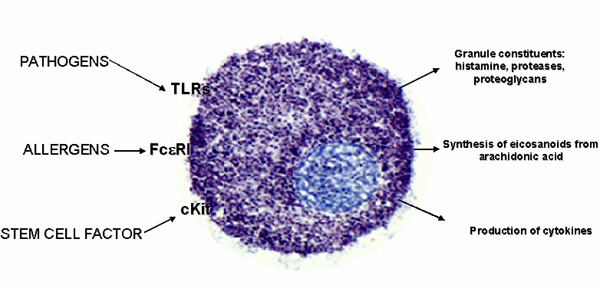
White blood cells (WBC) known as lymphocytes, or T-cells and B-cells,  make a type of antibody known as IgE . When an IgE antibody encounters an allergen whose shape "fits" ( in a similar way that a key fits only the one lock) the two bind. Binding of antigens to IgE on mast cells  triggers release of irritating chemicals like histamine and other inflammatory cytokines.

image of a mast cell courtesy of http://www.nutritionreview.org


This leads to itching, redness, irritation, and swelling or inflammation.
When the pet scratches, bites and licks, the inflamed itchy skin gets secondary opportunistic bacterial and fungal infections, which exacerbate the itching, scratching,  licking....odors and discomfort....and the cycle continues, getting worse and worse.


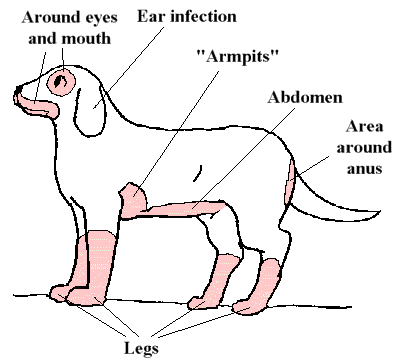
While the symptoms of atopy in people are  hay fever, eczema or asthma,  and while dogs and cats do get  bronchitis and asthma, just like people; the symptoms of atopy or atopic dermatitis in dogs unlike people are instead: itchy feet, itchy faces, itchy arm pits, itchy butts, itchy ears & ear infections.
The reason for this is that  mast cells are concentrated in those areas of dogs' skin unlike people, whose mast cells tend to occupy the nasal sinuses and the respiratory tract. 

These symptoms usually are first noticed between one and three years of age. They are often seasonal ( at least at first), but can become year-round in Southern California.
Kitty is more challenging and symptoms of allergies are different than dogs. Cats tend to develop respiratory signs such as feline asthma frequently and the distribution of skin leasions is different than dogs.  Please see the veterinary partner link below.


If your pet is diagnosed with atopy at a young age,
if you are not entertaining plans to move to the moon or any other geographic area in the near future,
if  you have done your best to reduce allergens in the environment,
if you have tried frequent baths, antihistamines, omega 3 fatty acids
.....but are finding yourself or your veterinarian administering corticosteroids.........whether in the form of injections or pills--it is worth considering testing and hyposensitization/ desensitization.

The purpose of desensitization is to "reprogram" the immune system-- rendering it less reactive to antigens. A blood test is drawn to identify the antigens in our hospital. A specialist in dermatology can do a slightly more accurate test (intradermal allergy test) in which more allergens are tested, by injecting tiny amounts into the skin and examining it for wheal reactions. Once the antigens are identified, gradually increasing amounts are injected at home in a "cocktail. Initially injections are administered every other day and gradually reduced to one every three weeks.
The likelihood of success is 70-85% similar to people undergoing this therapy for allergies.

The laboratory we use for our tests and antigen cocktails: http://www.varlallergy.com/8.html

We have yet to run into a person who is not scared of giving their pet shots, as well as a person who in spite of initial reservations just can't do them. Most are surprised at how easy shots are to give with a bit of practice, and how little the pets mind them, especially if coupled with a treat.
The beauty of successful desensitization is that it is free of side effects seen with other drugs used on a chronic basis, and in the right patients are much less expensive and effective than repeatedly treating allergic flair ups with corticosteroid injections, antibiotics, antifungals, home remedies, lotions, potions and pills.

Many pets are helped considerably by frequent baths. Antigens adhere to hair and skin accumulating over time. It has been demonstrated that some allergens are absorbed through the skin. Frequent baths reduce the antigen exposure and provide temporary relief usually lasting several days, without the use of any drugs. We stock professional medical shampoos formulated for soothing, cleansing, hydrating and controlling itching. Since dogs' skin doesn't produce oils in sufficient amounts to moisturize their skin, when bathed frequently, it is important to follow baths with a good moisturizing conditioner to prevent over drying  of the skin, which will exacerbate itching.  We advise against blow drying for the same reason.

Systemic and topical antibiotics and anti fungals are used frequently on atopy patients who have been scratching or licking. We all have small number of bacteria and yeast coexisting happily on the surface of our skin, but moist inflamed skin with a defective barrier invites these normally harmless organisms to become opportunistic invaders. If you are smelling an odor on the pet it is likely your pet has an infection-healthy tissues don't smell. If you are seeing a brownish discharge on the nails, hair, skin or inside the ears, you might be seeing and smelling a common fungal (yeast) called Malassezia. The most common bacterial pathogen we see is Staphylococcus.
Once either causes an infection, they worsen the symptoms and  require topical and systemic treatment.

Omega-3-Fatty Acids found in oily fish such as salmon reduce inflammation of the skin in allergic patients ( as well as arthritic joints)  restore deficiencies of the lipid barrier in skin cells, and are synergistic with antihistamines.
We like Super Omega 3 by Carlson http://www.carlsonlabs.com/p-4-super-omega-3-gems.aspx   (dosing one capsule for 25lbs of body weight daily)
 or Nordic Naturals  http://www.nordicnaturals.com/petVet/nnpet_collection.php 
Both of these companies are committed to ensuring purity and potency, unlike products found in big box stores.

Antihistamines  block the histamine release from mast cells, and are effective in about a third of our patients. We suggest trying the older ones first, because in reducing sedative properties in newer generation antihistamines, the potency of reducing itching is also reduced. Also, with the exception of Benadryl, the other antihistamines don't seem to cause sedation in pets like they do in people. The following are worth trying: Clemastine (generic Tavist), chlorpheniramine (generic Chlor-trimeton), Zyrtec, Benadryl, Claritin. Generic antihistamines are as effective as brand names, and should always be tried with a good quality omega-3-fatty acid supplement. We suggest trying each for three weeks before deciding if it is effective. If the one being tried does not reduce itching in three weeks, try another, just like people with allergies try several before finding one effective for them.
  Given the relative lack of side effects even if taken long term (compared to corticosteroids) they are definitely worth trying.
 Be sure to avoid combination allergy drugs which combine antihistamines with decongestants and pain relievers--they are toxic to pets!

Quercetin is a bioflavonoid antioxidant found in pigments of plants. It is believed to stabilize mast cell membranes, preventing them from rupturing and releasing the inflammatory, allergy-symptom-causing  histamine into the surrounding blood and tissue in response to the IgE antibody. Its absorption is enhanced by bromelain.
We order our quercetin from Thorne Research: http://www.thorne.com/Products/Antioxidants-Flavonoids/Flavonoids/prd~SB330.jsp

Corticosteroids are potent antiinflammatory agents often used to treat patients with atopy by injection or  in pill form. All steroids (dexamethasone, triamcinolone/ Vetalog, prednisone, prednisolone, Temaril-P)  reduce itching very quickly by suppressing lymphocytes, thereby decreasing inflammation and providing quick relief, but they vary in their potency and duration of effects. Though quite useful short term for temporary relief of itching,  they can be terribly harsh drugs when used chronically. As we already know atopy is a chronic disease, therefore we can't rely on steroids to be the cornerstone of treatment. Their long term use should be avoided due to well known side effects of adrenal suppression, osteoporosis, hypertension, diabetes, weight gain, changes in the liver, predisposition to infections, and skin and hair texture changes. I do use steroids in patients for short term relief and  when everything more holistic has been tried and failed, especially if the pet is not very young.  On occasion topical steroids, with limited systemic side effects,  can be a useful adjunct for spot-treatment.   

Flea allergies throw a well managed atopic off course. Because allergic pets over react to many many allergens, it is very important that rigorous flea control is practiced. The effort invested in keeping an atopic patient's symptoms under control will be wasted by a single flea bite!
Cyclosporine (Atopica) was introduced as a treatment for allergies in dogs a few years ago. Its original use was as an anti-rejection drug in transplant patients. Although cyclosporine does not cause the same side effects as corticosteroids, when used long term,  the drug can cause nausea, and is more expensive than conrticosteroids.  Having said that, our local dermatology specialist who has been using the drug for over a decade feels it to be a very effective addition in our allergy tool box.
  
We usually examine the pets' diet in evaluating pets with skin diseases.
Food allergies  overlap with atopy in location on the dog's body and appearance, and can be challenging to diagnose.  There are no accurate blood tests for food allergies in pets--diagnosis rests on documented,  limited ingredient elimination diet trials.

Food allergies are seen with a fair frequency-they typically do not respond to corticosteroids and are present constantly without a seasonal pattern.  Even if your pet does not suffer from a food allergy ( and  though improving your pets' diet will not cure atopy)  a dietary evaluation is important because poor diet will make treatment of atopy very difficult, if not impossible. Wholesome nutrients, vitamins and minerals are needed for healing injured tissues and for optimal immune system function.

Our favorite diets for allergic pets are usually formulated with limited ingredients, do not contain genetically modified grains such as corn and soy, and often contain fish to increase the omega-3-fatty acids.
One commercial diet I find worth trying Fido on to help with allergies: http://www.wellnesspetfood.com/product-details.aspx?pet=dog&pid=72&dm=grainfree

Some tips to reduce  exposure to allergens in environment:
http://www.mayoclinic.com/health/allergy/HQ01514/

Dust mites
Encase mattresses and pillows in vinyl or semipermeable covers; wash all bedding every one to two weeks in hot water at least 54.4°C (130°F); other desirable measures include: reducing indoor humidity to less than 50 percent; removing carpet from the bedroom and carpet over concrete; avoid lying or sleeping on upholstered furniture.
Human or other animal dander
Keep pets away from the bedroom, carpeted areas, and upholstered furniture.
Cockroaches
Use chemical control measures and remove sources of food and water.
Pollens and outdoor molds
Avoid outdoor activities when pollen and spore counts are elevated.
Indoor mold
Eliminate water leaks and damp areas associated with mold growth; consider reducing indoor humidity to less than 50 percent.
Tobacco
Avoid exposure to active and passive tobacco smoke.
Air pollution
Consider limiting outdoor activities when air pollution levels are high.
HEPA filters
http://www.aafp.org/afp/2002/0801/p421.html (modified for allergic pets rather than people allergic To pets :-)


Dr. Wayne Rosenkrantz, a respected board certified specialist in veterinary dermatology discusses atopy: http://www.youtube.com/watch?v=Hrg62qxPY30
Animal Dermatology Clinic2965 Edinger Ave
Tustin, California 92780 
Phone: (949) 936-0066
Fax: (949) 936-0071
Email: infotustin@adcmg.com
http://www.animaldermatology.com/location/10/Animal-Dermatology-Clinic


Monday, June 18, 2012

How to help dogs cope with fireworks

I like to celebrate the 4th of July and LOVE a good fireworks show.

Yet,  I can't convince my dogs that our block is not being invaded by monsters from outer space.
They run from window to window every time there is an explosion- barking at every bang, dutifully protecting our homestead from bombs and missile attacks.
I believe they are not an exception--4th of July can be rough on our pets. Many are terrified.


Tips to help you & your dogs deal with the 4th of July


Be sure your pets are wearing ID tags  & are microchipped.
No one ever makes plans to lose their pet.....yet  it happens.

Consider desensitization before the 4th of July. 
Training is time consuming and needs to start early, but noise phobias are not healthy for dogs, and they do not get better without active training. 
In desensitization or counterconditioning  the dog is exposed to the stimuli (lights, vibrations and sounds of the fireworks) at a low enough intensity such that they don't feel threatened. The intensity is gradually turned up--while rewarding a " state of calmness" with food, favorite games, love, or shifting the dog's focus by engaging the pet in an alternative activity ( by giving simple commands the dog excells at executing).  The intensity of the stimuli should be turned down immediately if the pet exhibits signs of anxiety. 

Practically speaking one would play a video of  fireworks or a CD at a very very low volume.....slowly turning  the speakers  up--Only If the pet acts and looks relaxed. There are lots to chose from on You Tube, and professionally made CDs are avaialble for sale online.

The speakers are turned down at the very first sign of panting or other signs of fear.

This is sort of like "the frog in boiling water" story, according to which-- if you put a frog in boiling water it will of course immediately jump out to escape the danger.  Yet if you put it into cool and pleasant water and very gradually turn up the heat, the frog won’t notice until  the water is boiling. Or so the story goes.
Scared chihuahua puppy
 Since I am actually fond of frogs, I am not advocating boiling them-- but I do find the analogy useful in this context:  the goal to work towards is a dog immersed in sounds and sensations of the fireworks and yet feeling relaxed.

Baby steps!

Create a safe haven  where the dog can escape to-this might be an airline carrier, a closet, a bathroom or the space under your bed. Window coverings should be closed and music  played to mask the sounds. There is a fine line between rewarding the "state of anxiety" with attention thus reinforcing the undesirable fearful behavior,  and a calm owner’s comforting presence to help a noise- phobic dog cope with overwhelmingly scary stimuli.

I have no experience with the Thundershirt, but on some levels it makes sense...so, I would like to hear from those who use it.


Medications: check with your veterinarian before administering any of the following:

Over the counter:
    Melatonin:
  • For small dogs an oral dosage of  0.5 - 1 mg once a day.
  • For medium-sized dogs 1 - 3 mg of melatonin by mouth, about 2 times a day.
  • For large sized dogs  the amount can vary between 3 to 9 mg.
          Benadryl (diphenhydramine)-- free of  pain relievers (acetaminophen is common in combination allergy drugs) and decongestants

I have no personal experience with melatonin, though I am of the school of thought of " If it can't hurt, why not try it?"  Benadryl does cause sedation, which does not make it anxiolytic.

By prescription:
  • Alprazolam (Xanax): one of my favorite anxiolytic agents in the same family as valium. It will reduce anxiety if administered several hours before the stressful event, but can also cause paradoxical excitation, incoordination,  or not work at all. 
  • Acepromazine: does not relieve anxiety, per se. -it causes the pet to feel too tired to act on it. This drug is not as safe or effective at reducing anxiety as Xanax and  it depresses blood pressure.
Ideally, one experiments with the medications before they are needed, in order to avoid surprises.
Be sure to call the office well ahead of time. We will not be able to prescribe any drug to a pet who has not been evaluated in  12 months, is elderly,  or has a  medical disorder such as a heart condition.

Wishing you and your family a safe and enjoyable 4th of July!


Thursday, May 31, 2012

Summer is...fleas season


"There is a purpose for everything under heaven"

Hmmmmmmm.......................What about fleas?


What purpose is there to them....can you think of any?

As a vet, the first thing I think about is the misery they cause known as FAD. Veterinarians recognize FAD (flea allergic dermatitis) by the way it looks and by the location of the itch and the skin sores--typically the rump, the tail, inner thighs and groin.
  • It just takes one flea bite to trigger this miserable reaction in a pet allergic to fleas
  • After injecting its saliva and  introducing allergic proteins into your pets blood stream-the flea jumps off your dog--just like mosquitoes or bees do- once they've caused the allergic reaction.
  • Many pets in Southern California have allergies, and in addition to being allergic to all sorts of things in their environment they are allergic to to flea saliva, developing itching and  rashes lasting several weeks from a single flea bite. This is the reason we usually don't even see the culprit on the pet. 
  • the image is courtey of Google image search engine. Beachvethospital does not claim any copyrights.


If your pet  has FAD, I recommend scheduling a consultation. The intense itching causes skin infections, which will get worse causing your pet misery, and  need to be treated--usually with anti-inflammatory drugs, medicated baths and antibiotics. They will not get better on their own

Since I haven't been able to get God on the phone... unlike other people ,I don't have her on speed dial, so can't ask her why she created fleas-  I will dedicate the rest of this post to figuring out how to best wage war on them  ...as efficiently and quickly as possible. 

Fleas do not live on dogs or cats--you are only seeing the fleas  having lunch! 
this image is courtesy of Google image search engine, beachvethospial does Not claim any copyrights

Think of fleas seen on the pet as the tip of  an iceberg....for every flea sucking blood from  your pet, there are thousands  laying eggs, hatching into larvae in hospitable  warm environments in bedding, furniture, carpeting and outside.....multiplying below the surface.
 Ewwww! 

Step 1> Environmental Control.
If you can see fleas scurrying around on your pet and can afford to hire an exterminator, do!
If not, purchase flea bombs with insect growth regulators (IGR's) to avoid having to retreat the property once the eggs  hatch maturing to larvae & pupate, starting the infestation cycle again a month later.

There are products considered  nontoxic--such as borate, which desiccates the buggers.

Step 2> Treat the pet

I find Advantage, whose active ingredient is imidacloprid ( a nicotine analogue) generally very effective, so long as it is used properly --every 3 weeks; or Advantix on dogs only- monthly.
Advantage Multi contains imidacloprid and an additional ingredient useful as a heartworm preventative, broad spectrum dewormer and occasionally for treatment of sarcoptic mites.

  •  It is important to remember that all the spot-on  products need skin oils to distribute.

Therefore it is not advisable to apply these spot-on's the day the pet is bathed; because the oils have been stripped off by the shampoo.  Wait at least a couple of days after a bath before applying them.

I do not find garlic effective, and high doses are actually toxic to cats and dogs.

  • We are seeing good results in pets, allergic to fleas on monthly flea pills called Comfortis. 

There are reports on the internet associating Comfortis with seizures. My understanding is that combining Comfortis with high sustained doses of ivermectin  ( as a treatment for mites) can lead to seizures due to summation of action on the GABA receptors in the brain.

  • We also stock a little Capstar. It is a pill safe for both dogs and cats offering  very rapid flea kill- 30minutes. The advantage over the other oral medications, in my mind is that while being a systemic drug Capstar only stays in the body for one day.  This means that if there were any side effects-they should be gone within a day, and we have not seen any. The disadvantage, of course, is that the pill has to be given daily which is inconvenient.
  • Revolution is a topical product I tend to use for mite treatment in cats and dogs, more so  than flea control. Yet, we have some clients reporting that Advantage or Frontline stopped working for their small pet, and yet Revolution does a good job. 

We recommend  the owner use what works for their pet--there are likely local areas where fleas have developed resistance to some products and not others; keeping in mind that no product used on any pet will rapidly reduce an environmental infestation. 


Step 3> Repellent
Advantage or Advantix will kill the fleas, but not before they've had a chance to suck blood. In the process of biting the pet, fleas introduce their own saliva containing protein. Though these topical spot-on's do kill the fleas- it is not soon enough to prevent flea allergic dermatitis (F.A.D). 
I find spraying a washcloth with a good repellent pyrethrin product ( I like Ovitrol)  and wiping down the skin areas where fleas tend to get on the pet ( the rear) at least once weekly, helpful in creating a "shield" - repelling the nasty things.


Very important: do not use Advantix on Cats!
It is highly toxic to them causing tremors, seizures and death.
We managed to save one of two kittens last week, whose owner mistakenly applied Advantix for large dogs on. Only the larger of the two, a  black and white named Moustache made it after spending three days in intensive care.

Tuesday, May 22, 2012

That's what friends are for

We have several patients in our practice trained to be Seeing Eye Dogs for the Blind. Many caring people raise these puppies to go into service to help people. Besides guidance for the blind service dogs have been trained to help people in many different ways.

According to the Wall Street Journal, Service dogs can even pick up signs of dangers of diabetes in people:

"The dog's accuracy and speed can beat medical devices, such as glucose meters and continuous glucose monitors, according to doctors, owners and trainers. With their acute sense of smell, the dogs—mostly retrievers—are able to react to a scent that researchers haven't yet identified.


For centuries, doctors diagnosed diabetes by identifying sweetness in the urine of a patient. That scent comes from glucose that isn't absorbed when a person lacks insulin, but the chemicals produced during low-blood-sugar incidents have yet to be identified.

"Whatever is being secreted in that drop in blood sugar…we just don't know what it is," says Dana Hardin, a pediatric endocrinologist who works for  Eli Lilly & Co. in Indianapolis. Her goal is to identify what chemical compound the dogs smell, "not only to train dogs but to possibly make a device," she says.

Most of the interest in diabetic-alert dogs comes from people with Type 1 diabetes—and parents of children with Type 1—because they are more susceptible than people with Type 2 diabetes to serious problems of low blood sugar. Type 1 diabetes is an autoimmune disease characterized by the absence of insulin production, and requires daily insulin injections. People with Type 2, which is brought on by a combination of genetics, inactivity and obesity, have trouble processing insulin but don't necessarily require external insulin.

Incidence of Type 1 has been rising in the U.S. by about 2.5% to 4% a year for reasons scientists can't explain, according to several large-scale studies published in peer-reviewed medical journals. The number of people with Type 1 diabetes in the U.S. is between 1.3 million and 2.6 million, accounting for 5% to 10% of the total diabetics.

Type 1 diabetics work to balance their daily intake of carbohydrates with external insulin. Prolonged high sugar levels can lead to complications such as heart disease, kidney failure and neuropathy. But trying to keep sugars at a low level raises the risk of hypoglycemia, which can be lethal, particularly if a patient loses consciousness while driving or alone."


Perhaps it should not be surprising to learn that some dogs share their gift of sight with other dogs as well: